
You are using an out of date browser. It may not display this or other websites correctly.
You should upgrade or use an alternative browser.
You should upgrade or use an alternative browser.
Is Todd Austinson still available. I have one of his 10 n 1 chips need some info please
- Thread starter sprinter
- Start date

Todd is not around for many years now , what do you need ?
What’s a 3 bar chip and why is it better than a 2 bar chip?
To answer this question you must understand the ECM (your engine’s computer). Late model GM vehicles use one of 2 methods to determine the engine’s fueling needs: mass air flow or speed density. Mass air flow uses a sensor that actually measures the amount of air going into the engine, and from other data (engine speed, throttle position etc) can calculate the exact fueling needs. Speed density measures the manifold pressure, and its changes (along with engine speed and other related data) to meter fueling needs. On a naturally aspirated car (non supercharger/turbocharger) a 1 bar map sensor is needed, as the engine only operates in vacuum. The 1 bar map sensor can read from about 14.7psi vacuum (or negative pressure) to atmospheric pressure (0 psi). A 2 bar map sensor can read from 14.7psi vacuum to 14.7psi positive pressure (one bar vacuum, one bar pressure greater than atmospheric). In the same respect, a 3 bar map sensor reads from 14.7psi vacuum to 29.4psi positive pressure (one bar vacuum, two bar of boost pressure).
What are the disadvantages and advantages of each?
A mass air flow system can take into account different modifications (cam/heads etc) that are done to increase power, as the sensor can ‘see’ the additional air going into the engine and will add fuel as necessary. This is as long as the sensor is not maxed out, as mass air flow sensors have a limit to their readings. The speed density system is not as forgiving in its calibrations, as the calibration is usually set for a stock system. When major changes are performed on the engine, the computer reads the same manifold pressure levels as a stock engine, and the same amount of fuel is delivered, when more or less is really needed. So in this respect, a mass air flow system is better. It also does not use a restrictive sensor to meter air, as the mass air flow systems do. As I mentioned before, however, the mass air flow systems can be maxed out, so in a higher performance system, the speed density is the winner (and this is the main reason speed density is used on aftermarket ECM systems). In the syty application, however, this benefit did not exist.....
What does all this have to do with Syclones/Typhoons?
The SyTy’s use a speed density system, BUT the stock setup uses a 2 bar map sensor. So the ECM can only read up to 14.7psi of boost. So if the boost is raised above this amount, the ECM will not know the actual pressure, as the sensor is maxed out. Anything over 14.7psi would be read as 14.7psi by the computer. So fueling cannot be changed at higher boost, timing cannot be altered at higher boost levels, and boost control will not function efficiently (as the SyTy’s ECM controls boost also). So basically, for a person on a budget who wants a bit more performance out of their truck, it was a risky venture, as fueling wasn’t being compensated as the boost was turned up, timing would not be changed at higher boost levels, and the factory boost control was not operating as well as it could, all very dangerous situations, especially on vehicles so prone to detonate.
What’s the solution?
A chip calibrated for a 3 bar map sensor, to take advantage of the extended range of that sensor.
Advantages
FUELING A 3 bar chip now has the potential to add fueling at boost levels greater than 14.7psi. However, the stock setup is limited as the stock injectors are nearly maxed out (100% duty cycle). On the STG 3 bar chip,. the fueling is slightly leaner than stock, so a higher base fuel pressure can be run to deliver a bit more fuel at higher boost levels.
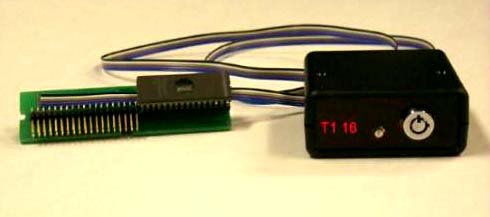
TIMING The timing can be modified on a 3 bar chip at higher boost levels, for either safety or performance. On the STG Display chip, there are 3 levels of timing, for different performance levels (to be used with higher octane gas also). The levels are designated T1,T2,T3 (T3 most aggressive timing, T1 mild timing, stock like). Also, on each program, the timing is MUCH lower above the set boost level, in case of a boost spike or creep, the timing will drop significantly, hopefully enough that no damage would have been done.
BOOST CONTROL The boost control on the 3 bar chips has the potential to control boost up to 30psi, BUT the stock wastegate is very undersized. If the stock wastegate is ported or if an upgraded integral is used on a larger turbo, boost control will be solid, with fine adjustments possible on the multi chip. So with this chip, there is no need for an aftermarket boost controller. No boost controller will work well with an improperly sized wastegate.
Special Features in the STG 3 bar chips:
What’s a 3 bar chip and why is it better than a 2 bar chip?
To answer this question you must understand the ECM (your engine’s computer). Late model GM vehicles use one of 2 methods to determine the engine’s fueling needs: mass air flow or speed density. Mass air flow uses a sensor that actually measures the amount of air going into the engine, and from other data (engine speed, throttle position etc) can calculate the exact fueling needs. Speed density measures the manifold pressure, and its changes (along with engine speed and other related data) to meter fueling needs. On a naturally aspirated car (non supercharger/turbocharger) a 1 bar map sensor is needed, as the engine only operates in vacuum. The 1 bar map sensor can read from about 14.7psi vacuum (or negative pressure) to atmospheric pressure (0 psi). A 2 bar map sensor can read from 14.7psi vacuum to 14.7psi positive pressure (one bar vacuum, one bar pressure greater than atmospheric). In the same respect, a 3 bar map sensor reads from 14.7psi vacuum to 29.4psi positive pressure (one bar vacuum, two bar of boost pressure).
What are the disadvantages and advantages of each?
A mass air flow system can take into account different modifications (cam/heads etc) that are done to increase power, as the sensor can ‘see’ the additional air going into the engine and will add fuel as necessary. This is as long as the sensor is not maxed out, as mass air flow sensors have a limit to their readings. The speed density system is not as forgiving in its calibrations, as the calibration is usually set for a stock system. When major changes are performed on the engine, the computer reads the same manifold pressure levels as a stock engine, and the same amount of fuel is delivered, when more or less is really needed. So in this respect, a mass air flow system is better. It also does not use a restrictive sensor to meter air, as the mass air flow systems do. As I mentioned before, however, the mass air flow systems can be maxed out, so in a higher performance system, the speed density is the winner (and this is the main reason speed density is used on aftermarket ECM systems). In the syty application, however, this benefit did not exist.....
What does all this have to do with Syclones/Typhoons?
The SyTy’s use a speed density system, BUT the stock setup uses a 2 bar map sensor. So the ECM can only read up to 14.7psi of boost. So if the boost is raised above this amount, the ECM will not know the actual pressure, as the sensor is maxed out. Anything over 14.7psi would be read as 14.7psi by the computer. So fueling cannot be changed at higher boost, timing cannot be altered at higher boost levels, and boost control will not function efficiently (as the SyTy’s ECM controls boost also). So basically, for a person on a budget who wants a bit more performance out of their truck, it was a risky venture, as fueling wasn’t being compensated as the boost was turned up, timing would not be changed at higher boost levels, and the factory boost control was not operating as well as it could, all very dangerous situations, especially on vehicles so prone to detonate.
What’s the solution?
A chip calibrated for a 3 bar map sensor, to take advantage of the extended range of that sensor.
Advantages
FUELING A 3 bar chip now has the potential to add fueling at boost levels greater than 14.7psi. However, the stock setup is limited as the stock injectors are nearly maxed out (100% duty cycle). On the STG 3 bar chip,. the fueling is slightly leaner than stock, so a higher base fuel pressure can be run to deliver a bit more fuel at higher boost levels.
TIMING The timing can be modified on a 3 bar chip at higher boost levels, for either safety or performance. On the STG Display chip, there are 3 levels of timing, for different performance levels (to be used with higher octane gas also). The levels are designated T1,T2,T3 (T3 most aggressive timing, T1 mild timing, stock like). Also, on each program, the timing is MUCH lower above the set boost level, in case of a boost spike or creep, the timing will drop significantly, hopefully enough that no damage would have been done.
BOOST CONTROL The boost control on the 3 bar chips has the potential to control boost up to 30psi, BUT the stock wastegate is very undersized. If the stock wastegate is ported or if an upgraded integral is used on a larger turbo, boost control will be solid, with fine adjustments possible on the multi chip. So with this chip, there is no need for an aftermarket boost controller. No boost controller will work well with an improperly sized wastegate.
Special Features in the STG 3 bar chips:
- Limit boost during first acceleration disabled,
- Turns on intercooler pump when engine coolant reaches 60ºF thus eliminating the need and disadvantages of hard wiring the intercooler pump to run continuously.
- RPM limit raised to 5400RPM,
- Overboost fuel cut retained for safety reasons (2-3psi above boost level for that program),
- EGR disabled in T3 (aggressive timing) programs, so as to not heat up intake (cruising to/from staging lanes),
- Max knock retard raised (the stock amount of retard is limited to 12.66º, we raise this max to 18º).
Performance Features:
- 3 different timing curves, from mild to aggressive,
- Several boost levels, from stock to 24psi.
Additional Ultimate Chip Features:
- Key lockable switching feature which is nearly impossible to defeat. With the key removed, programs cannot be changed, including a "no start" setting which is an excellent security feature.
- Valet setting with significant full throttle power reduction and a 4000RPM limit.
- Dimensions on display/switching unit: 6"x4"x2".
- Cable length of approximately 5 feet.
Notes:
The program selection will be displayed on the Ultimate Display chip, showing what timing level (T1,T2,T3), and what boost level (in PSI).
As was mentioned above, speed density ECM’s usually need chip updates/reprogramming for every little modification. Our programs seem to work well on trucks with mild modifications (intercooler modifications, turbo upgrades). Trucks with wild modifications (high lift cams/ported heads/significantly larger turbos) will not run as well as a lightly modded truck using these programs. In the future, I hope we can offer programs for trucks with serious upgrades, and perhaps design some buildup plans that can utilize our programs, as the alternative (aftermarket ECM) is the only real solution right now, and is an expensive one.
The program selection will be displayed on the Ultimate Display chip, showing what timing level (T1,T2,T3), and what boost level (in PSI).
As was mentioned above, speed density ECM’s usually need chip updates/reprogramming for every little modification. Our programs seem to work well on trucks with mild modifications (intercooler modifications, turbo upgrades). Trucks with wild modifications (high lift cams/ported heads/significantly larger turbos) will not run as well as a lightly modded truck using these programs. In the future, I hope we can offer programs for trucks with serious upgrades, and perhaps design some buildup plans that can utilize our programs, as the alternative (aftermarket ECM) is the only real solution right now, and is an expensive one.